Project Egaeras
"Where escapism and daydreams walk hand in hand"
Site work in progress!
Find me on Discord: @hypnoscapism (mellie)
About
This site is where I'll document the (slow) building of the world of Gidinna.Project Egaeras is a passion project that was born from a small idea about a princess saving her kingdom, and has now grown to be more than just that one small story. Gidinna is a magical world inhabited by both humans and a powerful race Muvacus (short for Muou Vahisia Dracus, i.e. form-changing dragon), along with their gods and goddesses who have bestowed powers upon the mortal races. Split in five long eras, Gidinna has a lot of history. Get to know some key characters, get a glimpse of the culture and language of Gidinna's inhabitants.
Navigation
Terms of Use
Welcome to the site dedicated to Project Egaeras! By accessing or using this website, you agree to comply with and be bound by the following terms and conditions. Please read them carefully.1. Ownership of Content
All content on this website, including but not limited to text, artwork, characters, stories, and designs, is the intellectual property of Mellie/@hypnoscapism and is protected under applicable copyright laws and treaties.You may not:- Copy, reproduce, modify, or distribute the content without prior written permission.
- Use the content for commercial purposes without a licensing agreement.2. Permitted Uses
You are welcome to:- Share brief excerpts or summaries of content from this website for personal or non-commercial use, provided proper credit is given and a link to the original source is included.
- Create fanwork, such as fan art, fanfiction, or original characters (OCs) inspired by this universe, under the following conditions:
- Credit the original source (this website's address and @hypnoscapism) clearly and prominently.
- Do not use the fanwork for commercial purposes without explicit permission.
- Avoid content that misrepresents, defames, or misuses the original work or characters.3. Prohibited Uses
You may not:- Claim any part of the website's content as your own.
- Use the website’s content in any manner that violates applicable laws or infringes on copyright.4. Disclaimer
The content provided on this website is for informational and entertainment purposes only. I make no guarantees about the accuracy or completeness of the information provided.5. Reporting Violations
If you believe any content on this site has been misused or infringed upon, please contact [email protected] or @hypnoscapism on mentioned social medias.6. Changes to These Terms
I reserve the right to update these Terms of Use at any time. Changes will be effective immediately upon posting.7. Contact Information
For questions or permissions, please contact: @hypnoscapism on any social media listed in the socials tab, or my email address [email protected].
History
"The era of Gods"
"The first era of mortals"
"The second era of mortals"
"The third era of mortals"
"The era of new peace"
The history of Gidinna is split into five eras. These eras are calculated in Moon Years, which was the original way of measuring longer time periods.A single Lunar Year is around 500 sun cycles (or regular years in our speech), which is the time in which the two moons of Esturna, Mealla and Rathnait (more in the World page), switch places. Humans don't care about this transition, but the Muvacus consider it as an event worth celebrating (see Moonfest).
1st era: The era of gods
The first era in the Gidinnian history is mainly dedicated for the emergence of the deities, thus the name. Gidinna was originally ruled by gods and goddesses, until the first mortal race came into existence. This race was the Muvacus, form-changing dragons, who would dominate land, seas and the sky. Muvacus eventually split into multiple subraces, the biggest ones being Capriscus and Avericus, who would fight for the favor of the gods continuously (Avericus being more active to do so, however). During this era, humans did not exist yet.The first era lasted for thousands of sun cycles, or multiple Lunar Years.
2nd era: The first era of mortals
The second era in Gidinnian history is the era when the gods departed from the world and left the world for the Muvacus to rule.Conflicts between Capriscus and Avericus became more common, but oftenmost they were easily solvable. Gidinna was equally split between these two races, the Avericus ruling the west and the Capriscus ruling the east.This era lasted around 4000 sun cycles, which is about 8 Lunar Years.
3rd era: The second era of mortals
The third era marks the arrival of humankind. With the permission from the divines, they were allowed to stay. The Capriscus welcomed the humans more warmly than Avericus, though some people preferred the company of Avericus. During this time, humans learned the habits and ways of the two races. The humans favored by Capriscus would receive Blessings from the gods, while the humans interested in the Avericus would learn how to fight like Avericus warriors.This era lasted around 2000 sun cycles, or about 4 Lunar Years.
4th era: The third era of mortals
The fourth era began after The Great War. With the new dominion of humankind, Capriscus and Avericus were hunted and driven to hiding, while the humans took control over the entire Gidinna. (lore work in progress). The destiny of Gidinna would eventually be altered with the help of the heir of Fate.This era lasted around 500 sun cycles, or one Lunar Year.
5th era: The era of new peace
The fifth era, also known as the modern era (current time), began after the union of all races inhabiting Gidinna, and is currently ongoing.Even during these times of peace, Capriscus and Avericus would still prefer their own homelands, but some brave ones move out, becoming a part of the human society.
Religion
The pantheon of the Gidinnian religion consists of four classes of deities, all of them with their own meaning and role. There are five gods of creation, multiple archdeities, some recognized protection deities, and a few ancient gods. These classes are separated into smaller subsections.The presence of divines is evident from the blessings given to mankind. In every nation within Gidinna (with the exception of Ethea) reside people who have been Blessed.Blessing is a gift inherited from one's parents, and gives the person magical abilities. These gifts originally derived from the gods, who gave these gifts for the Capriscus, and in succession, to kindhearted humans.
| Creation gods | Archdeities | Protection Deities | Ancient gods |
|---|---|---|---|
| Egaeras | Ten'zoh (Fate) | (not named yet) | (not named yet) |
| Chorum (Time) | Eveta (Dreams) | ||
| Nuah (Space) | Glai'cios (Frost) | ||
| - | Ver'ziele (Plants) | ||
| - | Thanatos (Life & Death) |
Blessings
Blessings are an ability of using magic. The Blessings originated from the ancient times, when gods gave Blessings to people they deemed worthy.Blessings are split in three main categories: nature manipulation (Natu Ma, NM), passive abilities (Pa'sik Litos, PL), and summoning a familiar (Con Famia, CF). A person can have at most two of the forementioned Blessing types (with some rare exceptions). The most common combinations are NM + PL and NM + CF. PL + CF is also possible, but more rare than the others. It's normal for a Blessed to have only one type of Blessing, in this case any of the above. A person with the ability to use all three of the Blessing types is called Sip Expa (SE, a.k.a. Master of Three).While all three Blessing types are inherited from parents, Con Famia is something a Blessed can learn even when not born with the natural aptitude for it if trained in a specific way.All types of Blessings are a threat to the Blessed and the people around themself if the usage of these powers is not taught properly. In modern society this has become an issue; many people are born with a Blessing, but there is only one official school to teach magic. There are other schools, but they're not funded by official sources, and often have shady side business, such as cults working within them. Due to the benefits gained from these unofficial schools, however, they've been allowed to exist despite their negative impact.
Natu Ma
Blessings belonging in the Natu Ma -class are related to nature and it's manipulation, as its name suggests. Blessed of NM type can manipulate a specific force of nature, such as water, ice, electricity, light, fire, or even vegetation. One with a NM-class Blessing can use their powers to destroy or heal, whatever the Blessed prefers.The techniques of NM usage is sorted in the following categories.Kusho Elaemen is the usage of NM in a traditional way of using charms, i.e. using the element as-is. This is the easiest technique to use NM, but it's hard to concentrate it to be powerful.Luom Arem is a technique of conjuring weapons using NM-magic. A weapon is formed by condensing a lot of NM-magic in the shape of the desired weapon of the Blessed. Weapons conjured with Luom Arem are often stronger and lighter than their physical counterparts.Pahrace Arem is a technique of enhancing one's own physical weapon with NM-magic. A Blessed can, for example, cover their physical weapon in NM-magic, thus enhancing the weapon's power. This is a very difficult technique to master, but a very rewarding one.
Pa'sik Litos
Pa'sik Litos -related abilities are also called passive abilities. These abilities are within the person themselves, and rarely are able to manifest outside their bodies. Abilities in Pa'sik Litos -class are, for example, foretelling, mind reading, enhanced senses and so forth.Abilities considered to be Pa'sik Litos -abilities are of divine origin, meaning that the owner of such abilities is related to the god with dominion over that specific ability by blood, e.g. demigods. These abilities can be inherited, but will dilute within two generations, making them incredibly rare.Overusing these abilities has negative effects on the user, because a mortal body is not able to handle their strength.
Con Famia
Con Famia, in all of its simplicity, is a technique of summoning a familiar, Famia. When learning Con Famia, it's important to have the look of the Famia determined early, so that it's easier and faster to learn the conjuring itself.Famia is a being that will fight alongside its Blessed master. Famia can be anything its master wants it to be, oftenmost being either an animal or a humanoid. Famia has its own NM ability, that most commonly matches the one of its master. In the case when a Famia has its own NM-element and abilities, it's called Hnat Famia, or independent Famia. Hnat Famias can also decide their own forms, and they are more conscious about their surroundings and themselves than regular Famias.
Peoples of Gidinna
In Gidinna, many diverse races exist side by side. Very loosely, all of them (excluding animals) could be divided into two species: humans and Muvacus.Muvacus (Muou Vahisia Dracus, a.k.a. form-changing dragon) are creatures capable of shapeshifting between a humanoid and a beast form. All Muvacus are a type of dragon, with varying features. Muvacus have existed ever since the second age, before humans, making them the original species to dominate Gidinna. They all originate from the small island in the east, Kyojou.Regarding the new understanding of the religion of Gidinna and the Blessing system, the shapeshifting ability of the Muvacus could be comparable to Pa'sik Litos -type abilities, although it is unknown whether these abilities originated from gifts given by the gods, or they simply are an inborn species-related ability.Some Muvacus have integrated into the human society of today, though hiding their animalistic traits either fully or partially. These Muvacus are oftenmost those that do not belong in the three major Muvacus races (Avericus, Capriscus and Piscus), and have no distinct animalistic features in addition to animal ears, such as horns or wings.Avericus, Capriscus and Piscus are the three dominating Muvacus-races. Dividing them roughly, Avericus are capable of flight, Capriscus are land-dwelling with horns, and Piscus are those who live in the waters.
Major races
Mixed races
Other Muvacus
Humans
Humans are the most widely spread species within Gidinna. When they arrived, they were called "Children of Stars", due to the belief that humans originated from the stars. There weren't many humans in the beginning, and their arrival was taken with varying reactions. Avericus were careful, yet Capriscus kind and welcoming. Some humans received Blessings from the nature gods, which has been passed down generations ever since.During the Great War, humans managed to gain dominion over majority of Gidinna, causing Capriscus and Avericus to hide away in fear.Humans live around 80 sun cycles, but depending on their lifestyle, they can live either longer or shorter lives.
Avericus
Avericus are a race of Muvacus living above the ground, who used to coexist with Capriscus ever since the Second Era. Compared to Capriscus, Avericus are more territorial and aggressive. Avericus have always been very aware of their territory, and have always fought hard to defend it from invaders. Still, Avericus are also known for their great sense of honor, not causing conflict without reason.Avericus were a very modern civilization ever since they first emerged, mastering the art of trade and currency. It is believed that Avericus were looked after by the Gods of Society, who taught them law, trade, and other societal skills. Avericus have a very strict hierarchy, in which is possible for everyone to rise the ranks, or descend as a punishment.Avericus weren't close with the nature gods, and never received Blessings, unlike their kin Capriscus.Avericus live for around 300 sun cycles.Avericus are humanoid people with large wings and ears covered in feathers. Their original form was a feather-covered dragon. Avericus are slightly smaller than Capriscus.Avericus used to be a very diverse race, having feathers in all colors of the rainbow (similar to exotic birds), but during the Great War, individuals with bright-colored feathers were an easier target for the humans and were hunted to extinction. After the Great War, only Avericus with feathers in muted colors exist (at least within the mainland of Gidinna).
Capriscus
Capriscus were a race of Muvacus living alongside Avericus ever since the Second Era. Of the two, Capriscus were kind, compassionate, and peaceful. Capriscus were adept in the art of healing and protecting, and they're believed to be descendants of the nature gods.During the arrival of humans, Capriscus welcomed them warmly and taught them healing. The gods gave humans a Blessing similar to Capriscus, and Capriscus taught them to use them as well.Capriscus are very unique compared to the other Muvacus for their genderfluidiness. Capriscus (similarly to clownfish as an irl example) have an ability to change their biology to suit the society's needs, allowing them to avoid total extinction. The society of Capriscus is quite free-minded in general, allowing anyone to participate in needed tasks. This is said to be proof of their speculated divine upbringing. Capriscus are a very long-living race, similarly to Avericus, living up to over 300 sun cycles.Capriscus are humanoid people with horns of different looks, sizes and colors, and a thick, muscular tail covered in fur. Their ears resemble fluffy faun ears, and are tilted downwards. When Capriscus are young and their horns haven't yet developed, their ears point upwards, and eventually lower to make way to the growing horns. In their beast form, Capriscus are physically similar to kirins, with a bit longer bodies and thicker fur that covers all of their body.
Piscus
Piscus are a race of Muvacus inhabiting the seas and large lakes of Gidinna. They can be compared to merpeople by their appearance. In their usual form, Piscus have a fish tail, and their bodies are fully covered in scales. Some Piscus have white eyes they use to hunt in the dark depths. Piscus rarely get out of water, since they prefer the company of their own kind, so not many people actually know what their humanoid forms look like. The beast form of Piscus resemble merdrakes.Piscus live in small tribes, and although they don't have any specific god they follow, they consider the sun and the two moons sacred due to their light.
Demihumans
Halfblood, or demihuman, is the umbrella term for all the half-human races.
Caprihumans (first generation mix between a Capriscus and a human), linostis (heirs of Caprihumans of the distant past with no human interference since their original upbringing, nowadays considered their own race) and Averihumans (mix between an Avericus and a human) count as demihumans due to being half-human by genetic heritage.
Avericapriscus
Avericapriscus are a hybrid between an Avericus and a Capriscus. They are very rare as it is globally very frowned upon to reproduce with other races except your own.Avericapriscus have the physical features of both Avericus and Capriscus. Avericapriscus have large feathered wings that match their natural hair color, feather covered faun-like ears, and a tail that has feathers in the tip and sometimes along the crest as well.In the ancient times, Avericapriscus were the superior race due to their omnipotency in both melee fighting and magical abilities that came from their heritage, but they were killed after the Great War broke and the two Muvacus races were separated for good. Nowadays, if a Capriscus were to reproduce with an Avericus, it would be seen as extremely disrespectful.
Felicus
Felicus, or "neko", is a humanoid race of people with feline features, such as ears and a tail. They have cat-like agility and are very playful.Felicus are proud creatures, and want to please others. They are well liked among humans due to their cute appearence and compliance. Felicus is the actual name given for this race, but once they got more popular among humans, they started calling Felicus "nekos" due to their resemblance to nekos (also known as catgirls and catboys) from human-made fictional media in Old Earth.Though Felicus are said to be demihuman, they are not because they are a fullblood Muvacus subrace. The demihuman label was given to Felicus by humans themselves due to their humanoid form despite not genetically being demihumans.Felicus can have features from any feline animal, such as but not limited to: cats, tigers, leopards and even lynxes.
Characters
Here are all characters sorted based on their appearance in lore or their general role in the world.
In the future, you can click the character's name to learn more about them (still work in progress!)
The Light of the Two Moons (Book 1)
| Role | Characters |
|---|---|
| Protagonists | Lilly Adrian |
| Antagonists | Eralinde |
| Supportive | Victor Aru Eireve Astra |
The Stream of Crystallized Tears (Book 2)
| Role | Characters |
|---|---|
| Protagonists | Lijun River Yoo-Mi |
| Antagonists | TBA |
| Supportive | Yun Aunt Mao |
Leaders
| Nation | Leader |
|---|---|
| Acholan | King Uri & Queen Nava |
| Astoris | Oracle Jun |
| Argahn | TBA |
| Elaniris | King Salar |
| Ethea | King Ocarus & Queen Theroah |
| Iseia | Empress Yumiko |
| Kaylan | King Enrico |
| Mistitu | TBA |
| Mosihan | TBA |
| Paihan | Princess Eralinde |
| Risina | TBA |
World
The world is vast and full of mysteries – here you'll find everything you need in case you get lost in the cosmos.
Planets
Continents
Old Earth
This page contains spoilers!
Esturna
"The greatest creation of Egaeras"
Esturna is an Earth-like exoplanet located in the habitable zone of the star Heliavor, approximately 215 light-years from Earth. It's known for its breathtaking icy rings and two large moons.
Planetary Characteristics
Type: Terrestrial, Earth-like
Diameter: 12,750 km (similar to Earth)
Gravity: 1.02 g
Atmosphere: Nitrogen-Oxygen mix (78% N₂, 21% O₂, trace gases)
Average Surface Temperature: 15°C (59°F)
Orbital Period: 365 Earth days
Rotation Period: 26 hours
Esturna shares many characteristics with Earth, including a breathable atmosphere, temperate climate, and liquid water oceans covering 68% of its surface. Its slightly longer day and axial tilt of 23.7 degrees result in familiar seasonal patterns.
Ring system
One of Esturna’s most striking features is its vast ring system, composed primarily of ice particles mixed with traces of rocky debris. The rings span approximately 140,000 km from the planet’s surface and are divided into three major bands.When sunlight strikes the icy particles, the rings shimmer brightly, creating a dazzling display visible even from the surface. Under specific atmospheric and solar conditions, rainbow-like halos and iridescent arcs can appear in the sky — a phenomenon known as the Esturnian Spectrum.The rings also cast thin, sweeping shadows across the planet, especially during its equinoxes, creating cooler periods known as the Shadow Solstice.
Moons
Esturna is orbited by two large moons, Mealla and Rathnait, which follow complex, intertwined orbits.
Mealla
Diameter: 3,400 km
Orbital Period: 27 days
Composition: Rocky core, thin icy crust
Mealla, the larger of the two moons, appears silvery-white due to its icy surface. It has a stable orbit that heavily influences Esturna’s tides, similar to Earth's Moon.
Rathnait
Diameter: 2,700 km
Orbital Period: 22 days
Composition: Silicate rock with iron deposits
Rathnait has a warmer, golden hue thanks to its iron-rich surface. It orbits faster than Mealla, creating a fascinating celestial dance over time.
The 500-Year Cycle, aka. "Lunar Years"
Esturna's moons are locked in a 500-year orbital resonance cycle, during which they gradually shift dominance in the night sky. For centuries, one moon appears larger and brighter while the other is smaller or hidden. Over time, their positions reverse.During the transition phase — known as the Sky Shift — the moons align precisely, causing the Great Eclipse, a rare event where Mealla passes directly in front of Rathnait (or vice versa), briefly obscuring one moon behind the other. This eclipse lasts approximately 17 minutes and occurs only once every 500 years.The phenomenon has led to rich cultural lore among ancient civilizations, often symbolizing renewal or rebirth. Some natives in Gidinna celebrate this shift during a festival called "Moonfest".
Habitability
Esturna’s Earth-like conditions make it possible for it to sustain life. The planet’s stable climate, abundant water, and protective atmosphere provide an environment where complex life flourish.The moons’ gravitational influences, while more complex than Earth’s, contribute to strong ocean tides and dynamic weather patterns, encouraging biodiversity in coastal and aquatic ecosystems.The icy rings, while beautiful, have a minor cooling effect on the planet’s climate by reflecting sunlight. This effect is more pronounced in the shadowed regions near the poles, where temperatures drop several degrees during the Shadow Solstice.
Cultural significance
Esturna’s unique celestial features have inspired ancient civilizations, enforcing their belief in the Gods of Creation. The planet with brilliant ice rings and two moons in a slow, majestic cycle has given birth to cultures, beliefs, mythology, and so much more, symbolizing duality, change, and the passage of time.The Great Eclipse has particularly captivated the religious, often representing an omen or a turning point in prophecies and premonitions.
Gidinna
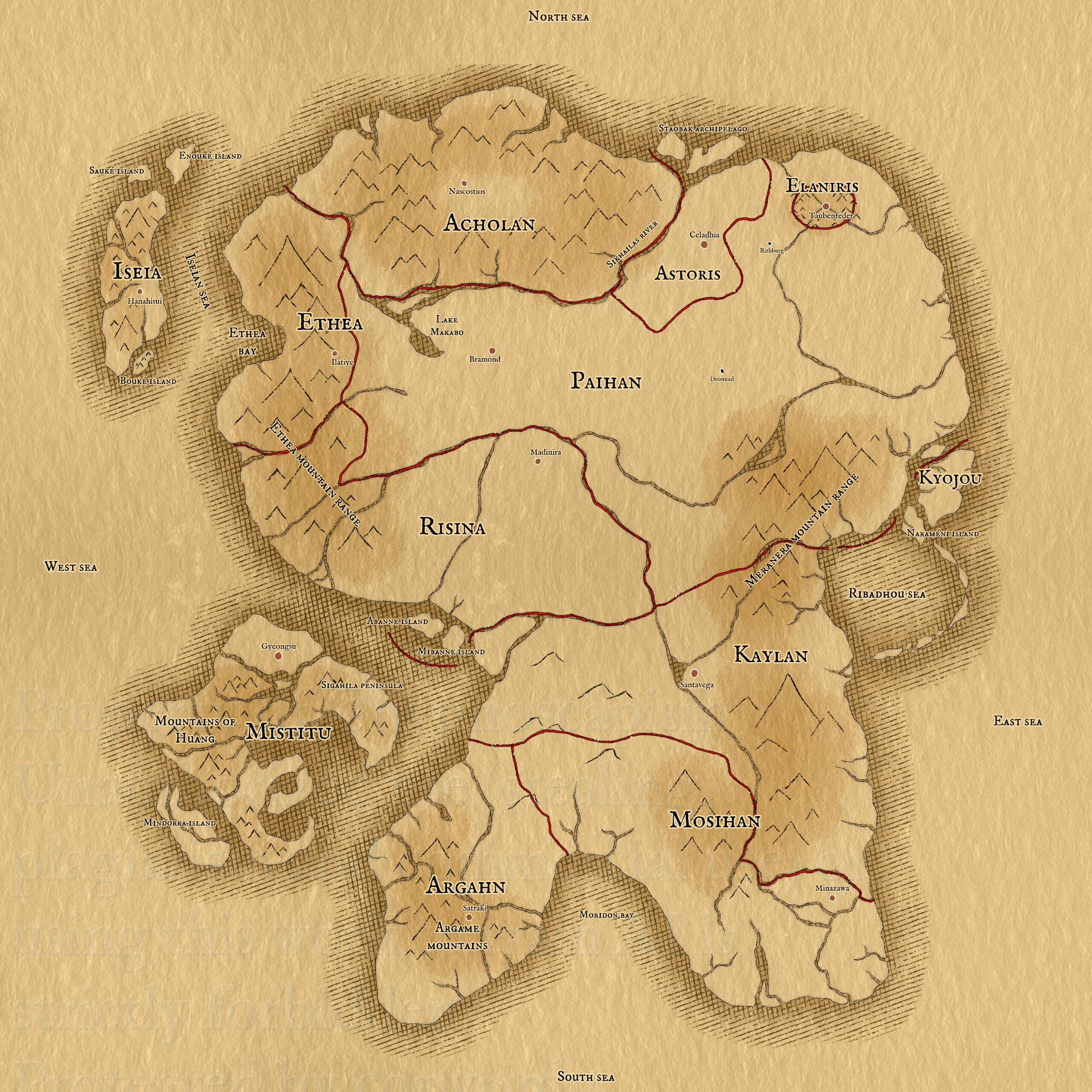
Gidinna is a large continent with a size of approximately 17 million km². It's located in the northern hemisphere of Esturna, providing comfortable living conditions to everyone residing there.Gidinna is home to a few intelligent lifeforms, along with a myriad of fauna and flora that make up a diverse, yet balanced ecosystem.
Map
Geography
There are eleven (11) nations in Gidinna, each having their own leader and a symbol. These nations have been divided into two major categories, Avereiris and Caprisceiris, based on their geological location and the ancient civilization (either Avericus or Capriscus) originally owning the corresponding territory.
| Avereiris | Caprisceiris |
|---|---|
| Ethea | Astoris |
| Paihan | Acholan |
| Iseia | Kaylan |
| Mistitu | Risina |
| Mosihan | Elaniris |
| Argahn |
Culture
Gidinna's cultures are rich. You've been given a chance to learn more.
Changelog
| Date | Changes |
|---|---|
| 21. Feb. 2025 | Added a map. |
| 23. Mar. 2025 | Added World page. Edited navigation in Main page. |
| 24. Mar. 2025 | New content in Culture. Edited the People page. Added information about Old Earth. Color adjustments. |
| 14. Apr. 2025 | Added socials in Socials page |
| 2. May 2025 | Added new map in Gidinna's page. Changed color theme slightly. Added a logo/icon for the project in the Home page. |
| 13. Jan. 2026 | Changed color theme |
Find me
If you're interested in the project and want to talk about it with other like-minded people (and me), join my Discord server!
Other socials